

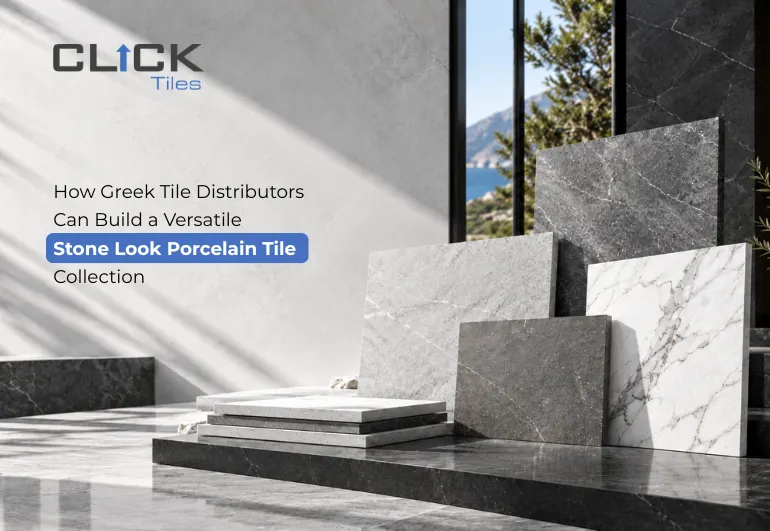
A showroom can display dozens of stone-inspired tiles and still leave customers struggling to find the right option. For Greek distributors, importers and dealers, the useful question is what each design adds to the collection.
A quiet apartment floor, a character-led hotel interior and a restrained retail space call for different choices. Build your stone look porcelain tile assortment around design variation, colour, format, finish and application. That gives every addition a purpose and helps showroom teams explain the range clearly.
A versatile stone look porcelain tile collection offers enough variation in colour, pattern, format and finish to serve different interiors and project requirements without unnecessary duplication.
Collection breadth means covering distinct design needs, such as light, understated surfaces and darker, expressive options. Collection depth means offering useful choices within a selected direction, perhaps another format or finish where available. Develop both around customer enquiries rather than catalogue size alone.
A useful stone look collection should give buyers clearly different design choices, not simply more designs to browse.
Subtle markings and gentle tonal changes give buyers an option for contemporary homes, apartments and understated interiors. Compare samples beside common companion materials, such as painted cabinetry and timber furniture. Keep designs that offer a visibly different undertone or pattern, rather than several near-identical pale tiles.
More visible veining, tonal movement or surface detail can suit feature-led spaces. Review several pieces together: one attractive sample may not show how strongly the pattern changes across a floor. Help dealers explain that visual character before a customer commits to a larger area.
For higher-end residential, hospitality or commercial briefs, consider how the pattern, format and finish work within the proposed room. A refined result might use restrained markings or a stronger focal surface. Treat “premium” as a design brief, rather than assuming a glossy finish or dramatic pattern automatically meets it.
Organise the shortlist into colour families so gaps and overlaps are easier to see:
Use these colour families to guide the shortlist, choosing shades that answer distinct customer needs. Compare undertones under the same lighting and ask which customer enquiry each option answers. Several almost identical greys may add less choice than one clearly warmer or darker alternative.
A useful format mix gives showroom teams different ways to respond to layout preferences. Across its porcelain range, Click Tiles offers 600×600 mm, 600×1200 mm and 300×600 mm formats.
Compare a scaled layout with the installer, including cuts and joints. Before recommending a format for a particular space, check the shortlisted product’s technical information as well as its dimensions.
Finish changes how a stone-inspired surface looks and responds visually to light. Click Tiles' 600×1200 mm porcelain range includes Matt, Polished, Carving and Glossy finish options. Available finishes can vary by design, so confirm the exact combinations for shortlisted stone-look products. Available finishes can vary by design, so confirm the exact combinations offered for shortlisted products.
Where a shortlisted design has suitable alternatives, compare them side by side. A different finish may answer another design brief without adding an unrelated pattern. Ask for a representative Carving-finish sample so buyers can see and feel the surface. For wet or demanding floor areas, check the product’s performance information before recommending it.
Versatility does not mean adding more SKUs. Before adding a stone-look design, ask whether it contributes a meaningfully different colour family, pattern character, format, finish or application opportunity. Confirm any proposed application against the product information.
If the design closely duplicates an existing option, it may make the range harder for showroom teams to explain without adding meaningful buyer choice.
Review the collection against enquiries your Greek dealer network actually receives.
For residential projects, can staff offer clearly explained options for living rooms, kitchens, bathrooms and open-plan interiors? A customer seeking continuity between rooms needs coordinated appearance and an appropriate specification for each space.
For retail, hospitality, offices and other project interiors, record the intended use, expected traffic and cleaning requirements alongside the design brief. Use room images for design inspiration, but confirm technical suitability from the product information before recommending a tile for a specific application.
Ask the supplier to confirm the following against the exact product codes on your shortlist:
Keep the confirmed answers with the quotation. This gives purchasing and showroom teams the same information when an enquiry becomes an order.
A strong distributor collection does not need every possible stone look. Aim for meaningful differences in design character, colour, format, finish and application, supported by the customer needs you can identify. That makes the assortment easier to present and more manageable to review.
Explore stone look porcelain tiles from Click Tiles and discuss suitable designs, formats, finishes and export requirements for the Greek market.
Start with the needs of your customers and projects. Build variety across design character, colour, format and finish rather than stocking several similar-looking options. Each addition should fill a clear gap in the existing assortment.
A balanced collection can include light neutrals, mid-tone shades and darker stone looks. The right mix depends on customer demand, so compare undertones and design variation rather than choosing several tiles that appear almost identical.
Multiple sizes can add useful choice when they support different layouts or project requirements. Confirm which formats are actually available for each shortlisted design and consider whether another size adds meaningful value to the existing range.
Confirm the exact product reference, available sizes and finishes, design variation, intended applications, technical information, packing details, samples, quantities, availability and relevant supply terms before finalising an order.
Review every new design against the existing assortment. If it does not introduce a meaningful difference in colour, pattern character, format, finish or application opportunity, it may add complexity without giving customers a genuinely new choice.
